The Credible Footprint: A Sustainable Identity Method for UK SMEs
Sustainability has become a familiar word in UK branding conversations, yet it is often treated as a visual register: muted greens, recycled textures and a leaf motif placed carefully beside a logo. For small and medium-sized enterprises, that approach rarely survives scrutiny. A more durable route is to treat sustainability as a design constraint that runs through procurement, production and digital delivery. In 2026, with customers, procurement teams and regulators paying closer attention to environmental claims, the strongest brand position is not the most decorative one. It is the most evidenced.
From palette to procurement
A brand identity is not only a set of colours and typefaces. It is also the paper on which it is printed, the packaging in which it travels, the website through which it is experienced and the signage that represents it in public. Before commissioning new assets, UK business owners should map where the identity actually appears. Which touchpoints are frequent? Which are costly? Which are replaced often? A brand manual can usefully include a sustainability note alongside logo clear space and colour codes, setting out approved substrates, print methods and digital performance expectations. This turns an aspiration into a specification that designers, printers and suppliers can follow.
The material ledger
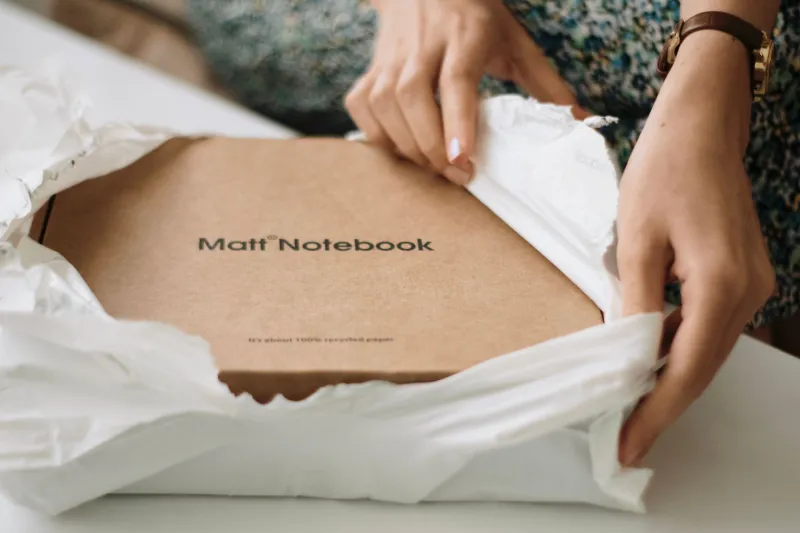
Print remains a credible and effective channel for many UK SMEs, particularly in professional services, retail and manufacturing. The environmental question is not whether to print, but how. Specify recycled or FSC-certified stock and ask for mill or supplier evidence rather than relying on a generic description. Choose printers that can demonstrate an environmental management system, such as ISO 14001, and discuss inks, coatings and laminates before artwork is finalised. Foil blocking, heavy lamination and mixed-material finishes can make recycling difficult; where they are essential, use them sparingly and record the reason.
Format decisions matter as much as material choices. Standardising stationery sizes can reduce offcuts. Designing packaging from a single material, where functionally possible, simplifies disposal for the customer. On-pack recycling guidance should be accurate for the UK context, and producers should understand their obligations under packaging extended producer responsibility. Claims such as “plastic-free” or “fully recyclable” require verification across the whole pack, including labels, adhesives and closures, not just the most visible component.
Digital weight and the invisible footprint
Digital design is often assumed to be weightless. In practice, websites consume energy through data transfer, hosting and the devices used to access them. Heavy hero videos, uncompressed imagery, autoplaying media and unused third-party scripts all add to page weight. A practical response is to set a performance budget within the brand and web brief: compress images in modern formats, lazy-load content below the fold, limit font families and weights, and question whether every motion sequence earns its place.
Accessibility and carbon reduction frequently align. Clear HTML structure, restrained animation and efficient pages tend to serve both users and the environment. Website carbon calculators can offer a directional estimate, but they should not be presented as a precise audit. If a hosting provider claims renewable energy, ask for the basis of that claim. The design studio’s role is to make the efficient choice the default, not an afterthought.
Communicating without overclaiming
The UK Competition and Markets Authority’s Green Claims Code sets a clear expectation: environmental claims must be truthful, clear, complete, not omit relevant information, make fair comparisons and be substantiated. Vague adjectives such as “eco-friendly”, “green” and “sustainable” are difficult to defend when used without qualification. Specific statements are stronger. “Printed on 100% recycled, FSC-certified stock” is more credible than “eco-printed”, provided it is true and the scope is explained.
Brand teams should maintain an evidence file for every public claim, with dates, suppliers and supporting certificates. Claims should distinguish between a company’s operational footprint and the impact of a particular product or service. Customer-facing teams need approved wording so that informal conversations do not outrun the evidence. Procurement questionnaires increasingly ask for this material, and a well-organised answer can be as persuasive as any campaign.
A compact brand sustainability audit for SMEs
- Map the ten most frequent brand touchpoints by volume, cost and replacement cycle.
- Obtain current certificates for paper, packaging and print suppliers.
- Record inks, coatings, laminates and adhesives used across regular items.
- Estimate annual print and packaging quantities, including waste and reprints.
- Review the five heaviest pages of the website and their image and video assets.
- List third-party scripts and remove those that are unused or unnecessary.
- Check that public environmental claims are specific and supported by evidence.
- Assign an owner and a review date for sustainability information in brand guidelines.
- Brief designers and printers on approved specifications before new work begins.
- Consider modular signage and reusable exhibition graphics to extend asset life.
Designing for longer use
Durability is an underrated sustainability strategy. A brand system that can adapt without wholesale replacement reduces waste and cost. Flexible layouts, digital templates and modular physical assets allow an SME to update messaging without reprinting an entire suite. Avoiding trend-dependent marks also helps: identities designed for a decade rather than a season are more likely to remain useful. This is not an argument for blandness, but for restraint in those elements that are expensive to change.
A credible sustainable brand does not need to claim perfection. It needs to be honest about scope, specific about materials and methods, and clear about what comes next. For UK SMEs, the most persuasive position in 2026 is a brand that can show its working — in the paper it specifies, the pixels it ships and the words it chooses.